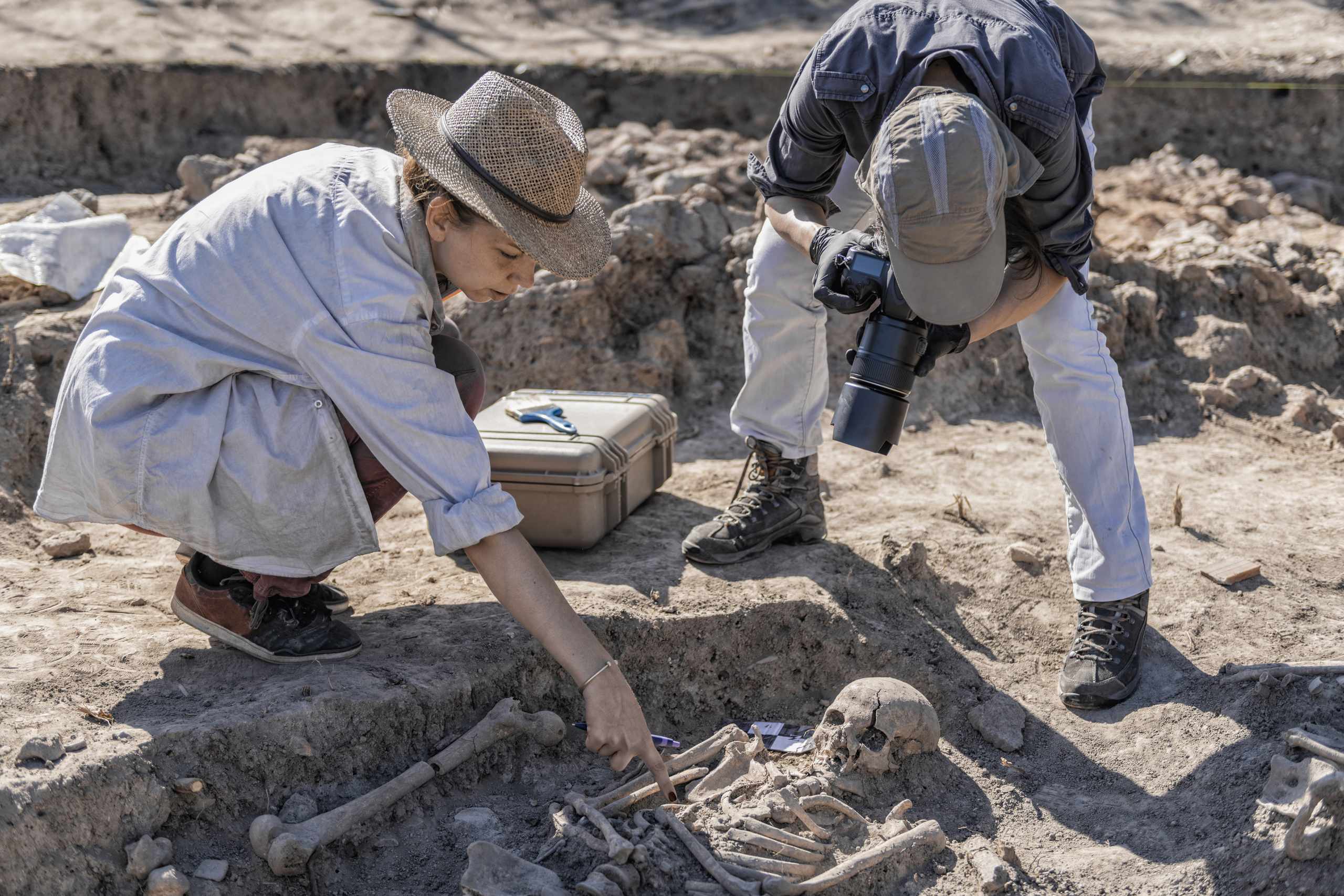
Artifacts shouldn’t be picked up when they are first exposed. Sometimes their exact location holds clues that will be lost if the surrounding soil is removed. Archaeologists take time to document the object itself, the context it was found in, and any relationship it might have to other objects and features in the excavation unit. This documentation helps ensure that what may appear to be a chance encounter with an isolated object remains evidence that can still be examined even after the excavation unit has been backfilled.
Try this: put a fake object in a box or tray filled with different colored sands or soils. Imagine that the box is your excavation unit. What would you need to write down in order to reconstruct the object’s precise position? Write down the object’s grid coordinates, its depth below a known benchmark, its orientation, its material, visible measurements, and its condition. Take a photo of the object next to a measuring stick and a card identifying the object. When you’ve finished lifting the object out of the dirt, would someone else be able to use your photos and notes to place it back in about the right spot?
Archaeologists would also describe the soil and matrix surrounding the object, the color, texture, inclusions, moisture content, and boundaries of the deposit that contains the object. Was the object in a closed deposit, next to a wall, in a pit filling, or near a root hole or secondary cut? Were there nearby ceramic sherds, charcoal, animal bone, stones, or metal pieces that might be related to this object? These relationships can be recorded without assuming that they are related.
Different records have to agree. The object number recorded in the field book should correspond to the number written on the photo tag, context record sheet, excavation plan, and sample label. Similarly, the unit and context numbers should match on all records. If you say that the object was found in layer 14, but the context label on the bag says 41, then you can’t be sure where the object really came from. It might seem tedious to have so much paperwork with multiple entries, but without careful numbering, the link between the object and the location where it was found is easily lost.
Often, new students only describe the object in the field book, perhaps because they assume that the object is the most important thing in the scene. “Small metal piece, possibly a buckle” doesn’t leave much room for follow-up questions. It would be better to describe the object in situ, as it was first found. For example: object found at 60.5 cm below datum, just north of the northern limit of context 12, lying flat and immediately adjacent to a patch of charcoal. Then you could include a note like “possibly a buckle.” That way, it is clear that “buckle” is an interpretation and not an established fact.
Once the exact position of the object, its surrounding context, and the required photos and drawings have been recorded, the object can be lifted out, properly packaged in an appropriately labeled archival bag, and returned to the lab for additional description and/or conservation. Doing this hastily could result in the loss of crucial information like the object’s orientation, any associated material, any trace residue on its surface, or delicate surface details. As a rule of thumb, always treat an object’s location as evidence first, and only after the location is well documented should the object itself be treated as an artifact.